YouTube Income Calculator – Estimate Earnings Per 1,000 Views
Use this YouTube Income Calculator to estimate how much creators earn based on views, CPM, niche, and audience location.
YouTube earnings spark endless curiosity among creators. One day, you see stories of massive paydays, the next you hear complaints about low payouts. The truth lies somewhere in between, shaped by factors like views, audience location, and content type. This guide breaks down how YouTube pays creators, what influences income, and how tools like a YouTube income calculator can help you estimate potential earnings without the guesswork.
Table of Contents
- How YouTube Creators Earn Money
- How Much Does YouTube Pay Per 1,000 Views?
- Factors That Affect YouTube Earnings
- Niche and Content Type
- Audience Location
- Watch Time and Engagement
- Ad Types and Fill Rates
- Estimated YouTube Earnings Examples
- Estimating Your YouTube Earnings More Accurately
- Are YouTube Earnings Calculators Always Accurate?
- Frequently Asked Questions About YouTube Earnings
- Helpful YouTube Tools & Resources
- Final Thoughts
How YouTube Creators Earn Money
YouTube creators primarily make money through the YouTube Partner Program (YPP). Once approved, you can earn from ads displayed on your videos. Eligibility requires 1,000 subscribers and either 4,000 watch hours or 10 million Shorts views in the past year.
Revenue comes from:
-
Ads: Pre-roll, mid-roll, display, and overlay ads
-
Channel memberships: Monthly fan subscriptions
-
Super Chat and Super Stickers: Live stream donations
-
YouTube Premium: Share of Premium subscription revenue
-
Merch shelf: Sales from integrated stores
Ads remain the main income source for most creators. YouTube takes 45% of ad revenue, leaving creators with 55%. Earnings aren't based on total views alone but on "monetized views" where ads actually play.
How Much Does YouTube Pay Per 1,000 Views?

The term CPM (Cost Per Mille) refers to what advertisers pay per 1,000 ad impressions. Creator earnings, often called RPM (Revenue Per Mille), represent what you actually receive after YouTube's cut.
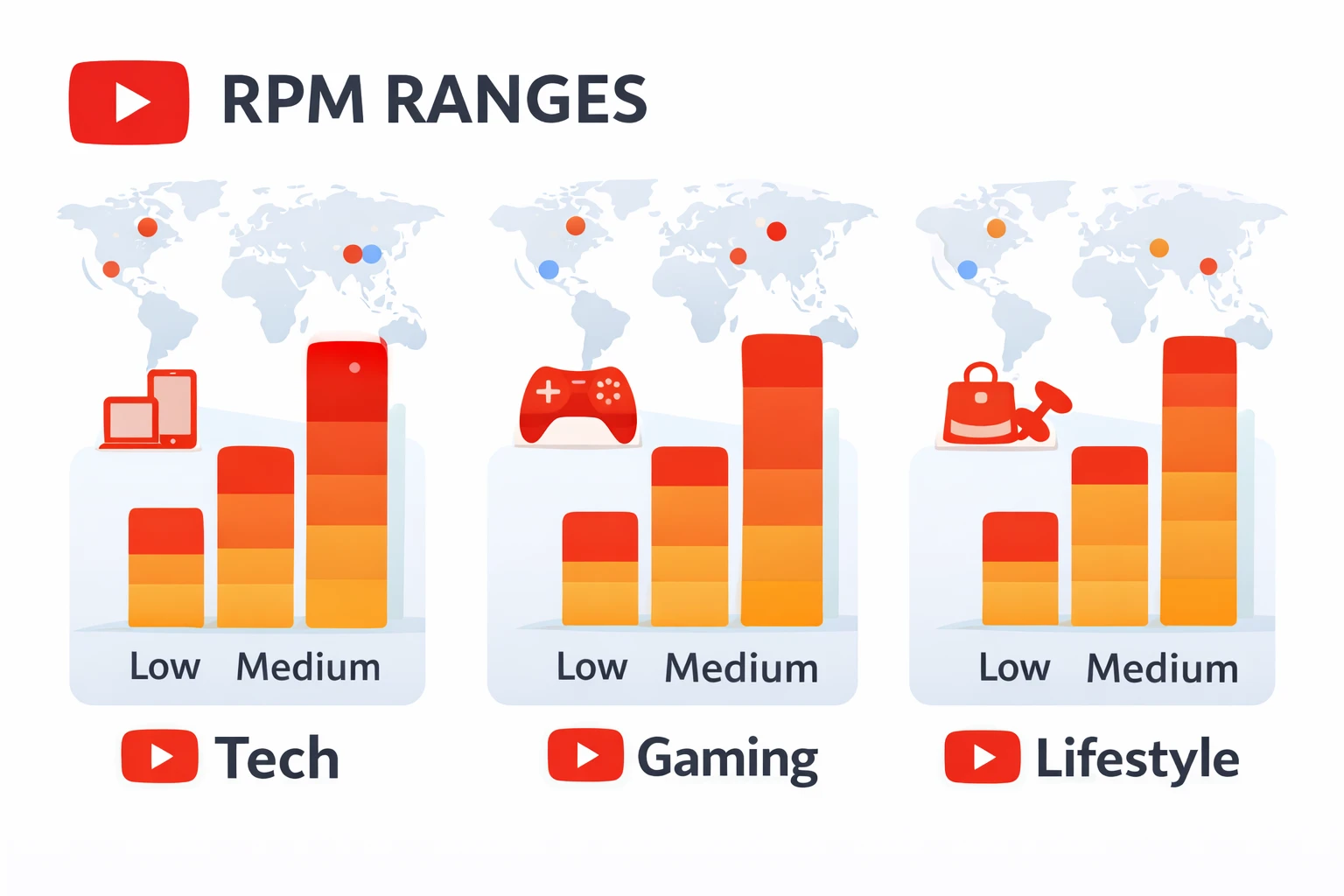
Typical RPM ranges from $0.25 to $4.00 per 1,000 views. Some niches see higher rates up to $10+, while others dip below $1. These figures represent monetized views only—skippable ads count only if watched for 30 seconds, Shorts have different metrics.
For context:
-
Tech reviews might earn $2-5 RPM
-
Gaming content often sees $0.50-2 RPM
-
Lifestyle vlogs typically fall in $1-3 RPM range
These are broad estimates. Your actual earnings depend on multiple variables we'll explore next. A YouTube income calculator uses these ranges to provide personalized estimates based on your channel stats.
Factors That Affect YouTube Earnings
Earnings vary widely due to several key factors. Understanding them helps set realistic expectations.
Niche and Content Type
Advertiser demand drives CPM rates. Topics like finance, insurance, and software attract high-paying ads. Gaming, vlogs, and comedy often see lower rates due to younger audiences or brand safety concerns.
High-CPM niches:
-
Personal finance
-
Real estate
-
Software tutorials
-
Health (non-medical)
-
B2B services
Lower-CPM niches:
-
Gaming
-
Reaction videos
-
Kids content
-
Music (non-licensed)
Audience Location
Geographic location heavily influences earnings. Viewers from high-income countries generate more revenue:
| Country | Typical RPM Range |
|---|---|
| USA, Canada, Australia | $3-10 |
| UK, Germany, Nordic | $2-6 |
| Other Europe | $1-4 |
| India, Southeast Asia | $0.10-1 |
| Latin America, Africa | $0.05-0.50 |
A video with 10,000 US views might earn $30-50, while the same views from India might bring $2-5.
Watch Time and Engagement
YouTube prioritizes viewer retention. Videos with higher watch time serve more ads, boosting earnings. The first 30 seconds matter most—viewers who skip early reduce your RPM.
Engagement signals like likes, comments, and shares also improve video recommendations, leading to more views over time.
Ad Types and Fill Rates
Not every view shows an ad. Factors include:
-
Ad blockers: Block 20-40% of potential revenue
-
Fill rate: Percentage of ad slots advertisers bid on (70-95%)
-
Ad format: Non-skippable ads pay more than skippable ones
-
Seasonality: Higher rates during holidays
Estimated YouTube Earnings Examples
Let's look at realistic scenarios using average RPM ranges. These are estimates only—actual earnings vary.
Example 1: Gaming Channel (100K views/month, $1.50 RPM)
Monetized views: 70,000 (70% ad view rate)
Estimated earnings: $105/month
Example 2: Tech Reviews (50K views/month, $4 RPM)
Monetized views: 40,000
Estimated earnings: $160/month
Example 3: Vlog/Lifestyle (200K views/month, $2 RPM)
Monetized views: 140,000
Estimated earnings: $280/month
Growth Scenario: 1 Million Views (Mixed audience, $2.50 RPM)
Monetized views: 700,000
Estimated earnings: $1,750/month
These examples assume 70% ad view rate. Additional revenue from memberships or Super Chat could increase totals 20-50%. Tools like YouTube income calculators let you input your specific views and niche for tailored estimates.
Estimating Your YouTube Earnings More Accurately
Manual calculations involve too many variables. YouTube income calculators simplify this by factoring in your niche, view count, and audience demographics. These tools use industry CPM data to provide realistic estimates.
For instance, our lets you enter monthly views and select your content category. It factors typical RPM ranges and ad view rates to show potential earnings. While not exact, it gives creators a practical benchmark for planning.
Are YouTube Earnings Calculators Always Accurate?
No tool predicts exact earnings. Calculators rely on averages and can't account for:
-
Your specific audience demographics
-
Real-time ad market fluctuations
-
Individual video performance
-
YouTube algorithm changes
They serve as planning tools, not guarantees. Use them alongside YouTube Analytics for the most accurate picture. Cross-reference multiple calculators and track your actual Analytics data over 3-6 months to calibrate estimates.
Frequently Asked Questions About YouTube Earnings
How much does YouTube pay for 1 million views?
Typically $1,000-$5,000, depending on niche, audience location, and ad performance. Gaming might earn $1,000 while finance could reach $5,000+.
When does YouTube pay creators?
Monthly via AdSense, between the 21st and 26th, for earnings from the previous month. Minimum payout threshold is $100.
Do Shorts views count toward earnings?
Yes, but Shorts have lower RPM ($0.01-0.07 per 1,000 views) compared to long-form content.
Can I earn money without 1,000 subscribers?
No for YPP ads, but affiliate links, sponsorships, and merch work immediately.
Why are my earnings lower than expected?
Common causes: high ad blocker usage, low audience value countries, short watch time, or seasonal ad rate dips.
How do I increase my YouTube RPM?
Target higher-value niches, improve retention, create US/EU-focused content, and diversify with memberships.
Helpful YouTube Tools & Resources
Complement earnings analysis with these free tools:
-
YouTube Trend Finder - Spot viral opportunities
-
YouTube Tag Extractor - Analyze competitor optimization
-
YouTube Hashtag Generator - Boost discoverability
Combine tools with YouTube Studio Analytics for comprehensive insights.
Final Thoughts
YouTube earnings depend on far more than view counts. Niche selection, audience quality, content retention, and ad market conditions all play crucial roles. While a YouTube income calculator provides helpful estimates, consistent content creation and audience building remain the foundation of sustainable income.
Focus on value-first content that keeps viewers watching longer. Track your Analytics monthly, experiment with niches, and use estimates as planning guides rather than promises. Earnings grow gradually as your channel matures and attracts higher-value audiences.

Popular Tools
Recent Posts


